
The 2026 OUR KIDS Private School Expo is coming to cities near you. Get your family pass


Academy for Gifted Children - P.A.C.E. THE OUR KIDS REVIEW
Verified Review
OUR KIDS verifies every review by confirming the reviewer’s identity and their firsthand experience with the school. Learn more
The 50-page review of Academy for Gifted Children - P.A.C.E., published as a book (in print and online), is part of our series of in-depth accounts of Canada's leading private schools. Insights were garnered by OUR KIDS editor visiting the school and interviewing students, parents, faculty and administrators.

Introduction
Located in Richmond Hill, Ontario, the Academy for Gifted Children—P.A.C.E. is a non-denominational, co-educational private day school. The acronym P.A.C.E. stands for Programming for Academic and Creative Excellence, reflecting the school’s highly specialized program that caters to children in Grades 1-8, who have been recognized as intellectually gifted. With a rigorous academic curriculum and teachers who nurture the social and emotional needs of gifted students, P.A.C.E. also offers a wide range of sports, extracurricular activities and opportunities to participate in local and national competitions. The school’s balanced approach cares for the whole child and ensures each student gains the skills and confidence to reach their full potential.
Since its establishment in 1993, P.A.C.E. has provided a highly specialized, challenging academic curriculum that meets the needs of the most intelligent children. Based on the premise that gifted children need high-powered learning experiences to challenge their minds and ensure intellectual growth and achievement, P.A.C.E. offers a differentiated curriculum built on greater depth and breadth of instruction using methodologies specific to gifted education. Using a “whole child” approach, P.A.C.E. provides a challenging yet supportive environment with a focus on math, science, technology, humanities, the arts, athletics, and a range of extracurricular activities and competitive opportunities. The school also strives to provide students with the intellectual skills, learning techniques, and strong value system they need to excel in life after graduation.
Housed in a newly renovated main building, students in Grades 1–5 enjoy a light-filled physical space with access to the latest technology, including personal digital devices, smart TVs, and a full suite of Microsoft applications. The building for Grades 6–8 was renovated in the summer of 2025 to mirror the space created for the school’s younger students. Since students in Grades 6–8 have already been using their own notebooks and laptops for years, technology has been integrated with smart TVs to allow for a seamless transition from learning in the school’s main building.
Key words for Academy for Gifted Children - P.A.C.E.: Giftedness. Rigorous. Whole-child.
Culture and value
Inside the classrooms, affirming mottos like “Mistakes help us grow,” “This is a safe space to be who you are,” and “I am smart, brave, creative, unique, loved, strong, kind” are displayed on the walls. These posters encapsulate the school’s values and ideals, reinforced daily by the school leadership and teachers:
Respect. P.A.C.E. is a safe and respectful environment where students learn that it is essential to be kind to each other. Meanness and rudeness are always addressed, and students are aware that these characteristics are not tolerated.
Integrity. Teachers and staff set the standard of good character, establishing the principle that students be moral people, demonstrating honesty and integrity in their daily lives.
Resilience. With a goal of ensuring that students are resilient and adapt well when faced with adversity, P.A.C.E. helps students develop self-care mechanisms to protect themselves from overwhelming experiences. Pursuits including meditation, yoga, exercise, and building close friendships are encouraged.
Problem solving. When faced with a problem, students are encouraged to troubleshoot and strategize, gaining the confidence and ability to logically approach problems and come up with viable solutions.
Critical thinking. P.A.C.E. provides students with the tools to become critical thinkers who learn to analyze the information given to them so they can decide what is true.
Pride. P.A.C.E. also believes it’s important for students to be happy and delighted in their learning and their accomplishments. Opportunities are plentiful for students to highlight their achievements and showcase their work to one another and their families.
“The thing that really helps a lot is the values P.A.C.E. teaches students—how to have critical thinking, how to decide right and wrong. P.A.C.E. does this really well, and I’m very grateful,” says Tim Li, a parent. His children are currently in Grades 5 and 1 at P.A.C.E. After looking at other schools for their gifted children, the family decided that P.A.C.E., which teaches more than academics, was the best fit. Tim and his family are confident they made the right decision.
The admissions process
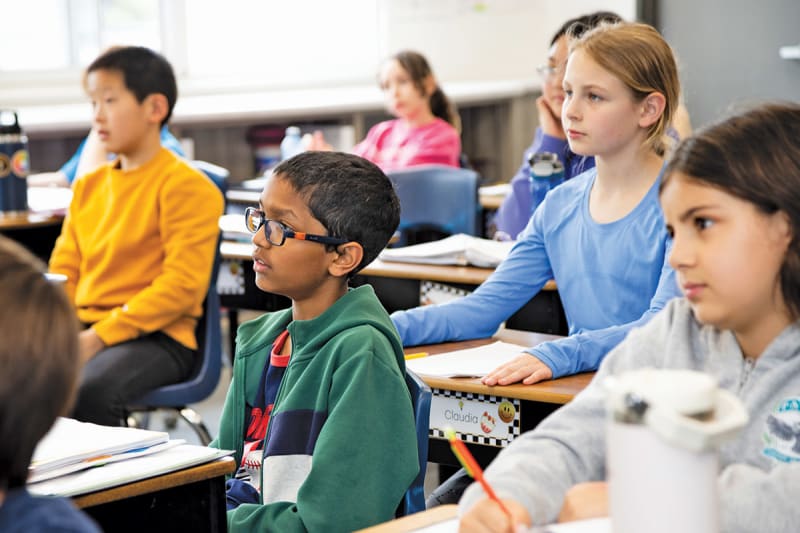
Children who score in the 95th percentile or higher in Full-Scale IQ (FSIQ) and/or General Ability Index (GAI) on standardized intelligence tests are welcome to apply to P.A.C.E. Prospective students must submit a psychoeducational assessment as part of their application. Interested families can schedule a time to meet with P.A.C.E.’s Vice Principal, Ms. Caroline Corbit or the school’s Director, Ms. Janice Gruchy. This is a meaningful opportunity for Ms. Corbit and/or Ms. Gruchy to learn more about each applicant and for parents to ask any questions they may have about the school.
While parents meet with P.A.C.E. leadership, child applicants learn first-hand what it’s like to be a student at the school by spending a day in class with their peers. This “day as a student” is an opportunity for prospective students to experience life at P.A.C.E. and get a sense of whether the curriculum would be a good fit for them. It’s also a time for teachers to determine whether P.A.C.E.’s unique program for gifted children is best suited for each individual child.
The school is a match for children who have an innate curiosity, are able to easily grasp concepts, have a thirst for knowledge, and a passion for learning. Teachers also assess whether potential students are respectful of teachers, their peers, and the learning environment, as it’s essential that all students behave in a way that enables all students to learn effectively.
After gathering information and determining whether potential students are likely to succeed at P.A.C.E., the school’s director, Ms. Janice Gruchy, will extend offers of admission. Admission occurs on a rolling basis. Larger entry years tend to take place in Grades 4 and 5, the grades immediately following those in which the public and Catholic school systems administer gifted assessments to their students, respectively.
Tuition at P.A.C.E. falls on the lower end of the independent school spectrum in Canada, offering a more accessible entry point than many comparable private institutions. Financial assistance is currently not available. In addition to tuition, families pay a one-time registration fee upon enrollment and an annual student fee, which varies depending on grade level and individual circumstances, such as whether a student owns their own musical instrument. This student fee supports the SACPACK (Student Activity Package), which includes items and services such as the school yearbook, student ID card, agenda, athletic program participation, academic contests, digital recordings of school concerts, and access to certain physical education materials. While some extracurricular activities may involve additional fees, all are optional. After-school care is available for younger students for a daily fee.
Technology requirements include the use of personal computing devices, with younger students using a tablet-laptop hybrid and older students expected to bring their own laptop. The school does not require a uniform, allowing students to dress in a way that reflects their individuality while adhering to an appropriate and clearly defined dress code.
Is P.A.C.E. a good fit for my child?
Depe Juneja’s daughter spoke early, read early, and, after being tested, was found to be “off the charts” smart. “That’s when we started worrying about her education,” says Depe. “She was already reading in daycare and helping teachers read to the kids. We thought it would be boring for her when she went to Grade 1.”
They’d never heard of P.A.C.E., but when a psychologist recommended it to the family, they reached out. The school turned out to be a perfect fit. Now, the family has two gifted children at P.A.C.E. “It’s been amazing and such a challenging school for my kids. All the parents we’ve spoken to agree they wouldn’t get this kind of gifted education in another private or public school—they aren’t teaching to this level of math and science.”
Depe says the school has been a godsend for their children. “It’s a phenomenal school, and we are very lucky to be here. There’s nothing I can say that would do it justice.”
As families like Depe’s know, gifted children tend to exemplify certain characteristics. Some may start to read or speak at an early age, enjoy having conversations with adults, or have an uncommonly large vocabulary. Others tend to be very interested in a particular subject, have an insatiable curiosity, ask big-picture questions, and aren’t satisfied with superficial answers. Gifted children are also known to have a highly developed sense of humour. They can be perfectionists who evaluate and critically judge others. They also tend to be concerned about ethics and are emotionally sensitive, creative, and enjoy taking risks.
It can feel exhausting for parents, at times, but this is exactly the kind of student who excels at P.A.C.E. “We love these qualities,” says Caroline Corbit, Vice Principal. “They are signs a child has a fire inside. The purpose of our school is to keep that fire burning.”
With a strong understanding of their needs, P.A.C.E. has become a magnet school for gifted children, and for good reasons. The educators are adept at addressing their needs, helping students learn to face their challenges with emotional balance and appropriate coping mechanisms that promote success in reaching each student’s personal potential.
“P.A.C.E. is great at providing children with wonderful, impactful learning experiences, in large part by leveraging its student body, which is comprised of individuals who love to explore their passions and interests,” says Gruchy. Indeed, P.A.C.E. would be an ideal fit for students who love to learn through tangential inquiry and questioning; thrive in a safe environment free of harassment and judgement; enjoy researching and exploring topics in greater depth and breadth; enjoy creative problem solving; like to be challenged and engaged with subject experts; love the thrill of competition; thrive working with like-minded peers; and who are looking for an environment where they can truly be whoever they are.
P.A.C.E. is tailored to a particular population and is not a jack-of-all-trades type of school. However, administrators will gladly refer children to other schools in cases where a child has not been identified as gifted or shows a strong exceptionality other than, or in addition to, giftedness.
Teachers
At P.A.C.E., students learn from a team of about 25 teachers, many of whom are subject-matter experts with advanced academic qualifications. This allows students to begin to model themselves after passionate, knowledgeable educators, who themselves embody intellectual curiosity and discipline. While the majority of teachers are members of the Ontario College of Teachers (OCT), subject-matter expertise takes precedence in the hiring process, especially in specialized areas such as computer science, drama, and music.
In addition, all teachers at P.A.C.E. receive extensive professional training before and after each academic year, so they can best address the unique needs of the school’s gifted learners and do so as a coordinated team. Since the curriculum is built on a greater depth and breadth of instruction, teachers are trained in varied methods of instruction. This includes acceleration and compacting, with a focus on higher-level thinking skills, problem solving, and inquiry-based learning.
Recognizing that intellectual giftedness is often accompanied by heightened sensitivity and intense curiosity, P.A.C.E. places strong emphasis on cultivating the soft skills teachers need to support, guide, and inspire these learners with empathy, patience, and nuance. Essential skills include demonstrating a positive attitude, communication skills, attunement to others, self-motivation and self-awareness, teamwork and collaboration, problem solving, decisiveness, flexibility, and being open-minded to new tasks and challenges. Ongoing professional development is also provided throughout the year.
Academic environment
“My children love the intellectual stimulation that classmates and teachers provide,” says Winnie LoBaker. Her two children were in public school, but neither was being challenged nor felt engaged. They both started at P.A.C.E. this year—in Grade 3 and 5—and today they are thriving. “They like that it’s a smaller school and teachers know all the students. They feel very well supported, and they also feel challenged,” says Winnie. “P.A.C.E. is tailored to gifted children. Now, my children are using their mental capacity as the school gets them thinking. I’ve seen them grow in terms of their knowledge, communication, and confidence.”
Winnie’s family discovered firsthand how P.A.C.E. goes beyond the Ontario Ministry of Education curriculum requirements with academic programming that is uniquely challenging, exciting, and specifically tailored to address the needs of gifted children. They also quickly learned that material is delivered in different ways than in a publicly funded school. For example, the Ministry’s grade four Core French curriculum is taught in P.A.C.E.’s grade one program. Similarly, while Rocks and Minerals are typically studied in Grade 4, P.A.C.E. includes that curriculum in the Grade 2 program.
“We believe in acceleration and compacting of material and are roughly two to three years ahead in every major subject discipline,” says Janice Gruchy, Director at P.A.C.E. Class sizes are capped at 22 students to ensure students receive appropriate attention while allowing for in-depth learning experiences and meaningful social interactions.
We had the chance to experience the academic environment at P.A.C.E. by spending a full day at the school and meeting with educators, administrators, teachers, and students. This helped us get a better understanding of the school while also learning how the curriculum is specially tailored to gifted students on a subject-by-subject basis.
Math
P.A.C.E.’s math program meets the needs of its precocious students by accelerating the curriculum by roughly two grade levels compared to publicly funded schools. The emphasis is on teaching students to model real-life experiences mathematically – posing and solving problems, questioning, collecting data, drawing conclusions, and evaluating solutions – which builds both critical and creative thinking skills. Key features include daily arithmetic drills (addition, subtraction, multiplication, division, square roots, exponents) to strengthen mental math; a “Problem of the Week”; independent and group problem-solving assignments; and preparation for math contests in Grades 3–8. Students develop a genuine love for math, along with the confidence, independence, and analytical skills that ensure a smooth transition to high school.
“School is not about memorizing facts,” says Gruchy. “What we want is for students to come up with critical information and synthesize solutions to problems. This is at the core of what we’re trying to teach students to further develop their skill set.”
Science
The science program at P.A.C.E. is all about curiosity, creativity, collaboration, and courage. Students are given opportunities to stretch themselves, to discover things they didn’t know about themselves, and to pursue their interests. Administrators are open to new ideas and hands-on field trips that benefit the child and support their learning.
We stepped into the Grade 8 science class and spoke to the teacher. “You can tell students really want to do well,” she says. “They get so excited and passionate. It’s incredible to see what they can do when you give them the right opportunities.”
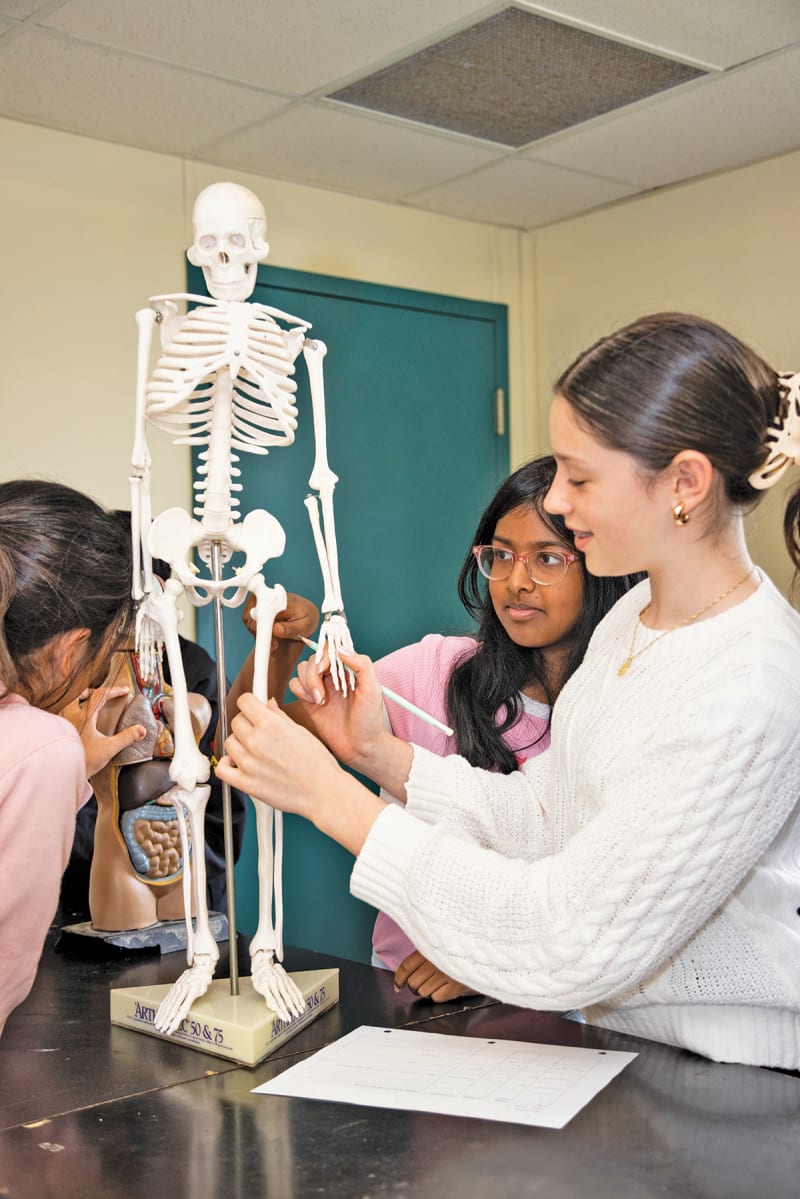
The science courses are advanced; students learn about the periodic table in Grade 4, rather than in Grade 9. By Grade 7 and 8, they are working on biology and concepts that students in public school wouldn’t learn about in depth until Grade 12. “When you introduce a topic at this age, students have a background, which is helpful for their future success,” the science teacher told us.
As part of the science program, students are exposed to experiential, hands-on learning. During their ecology unit, for example, Grade 8 students tested soil and water to determine whether an ecosystem was healthy. A science field trip at the start of the year saw the Grade 8s head off to space camp at The Cosmodome in Montreal, where they learned what it’s like to be an astronaut. “Every student has the opportunity to be successful,” says the teacher. “I try to connect them to the outside world. I want them to be excited.”
She has many examples of how she puts this concept into practice. During their astronomy unit, for instance, students learned about concepts of space and planets, but they had the chance to take their learning a step further. They were given four choices for an assignment so each individual could choose one that would best work for their learning style and interests. Some students did their projects on space ships and designs. Another looked at space movies to explain a scene and analyze whether or not this could actually take place in space.
To ensure students stay on track for success, teachers monitor their students closely. They hold one-on-one conferences before a project is due to ensure students are meeting expectations. It’s also a chance to identify any problems early on and catch any issues before students are graded. “They are all capable as long as they are willing to implement the feedback into their project or assignment.”
On the day of our visit, the Grade 8 students were hard at work in the science lab. Students were working on their projects for the national Let’s Talk Science Challenge, which combined space research with engineering. Each group was tasked with creating a prototype for a submarine that could explore Europa, the subsurface ocean of Jupiter’s moon. Some students had created physical prototypes, while others had made digital prototypes. One student even baked a cake of her prototype. The students’ projects are so detailed that they consistently win the competition every year.
Science Odyssey science fair
Another highlight of the science program for students in Grades 6, 7, and 8 is the Science Odyssey science fair. One of the school’s major initiatives, the Science Odyssey, is a chance for students to pursue their scientific interests, collaborate with peers, and compete in a supportive, nurturing way. The school opens its doors to parent volunteers who help make the experience a success.
One of our visits coincided with the science fair. We were amazed at the creativity, variety of topics, and depth and breadth of the projects, which covered biology, chemistry, physics, robotics, and more. A few highlights include speaking to a team of Grade 6 students who built an earthquake simulator using Lego, motors, and coding to test which kinds of surfaces could withstand earthquakes of different magnitudes. Another team developed a tool to help people with visual impairments sense their surroundings using sonars and buzzers. Another demonstrated a way to test a snake’s intelligence, arguing that snakes are social and can recognize themselves and each other.
Two Grade 7 girls invented a claw machine that operates using hydraulics. It took them hours to design and build. Now, the girls are experts: they can easily identify which claw machines are a scam based on their design. Another student was reading an article on fractals, a self-repeating pattern found in nature. She combined that idea with her interest in cancer. Realizing that certain cancers are fractals, she wrote a code to detect cancer through MRI imaging and differentiate between non-cancerous and cancerous cells.
Listening to the students discuss their projects, we clearly saw the value of their efforts in nurturing independent thinking and scientific curiosity, not in arriving at definitive answers, but in learning how to ask meaningful questions and explore them seriously and creatively.
English
The English program at P.A.C.E. is divided into four areas, providing students with a solid foundation in grammar, spelling, literature, and writing craft. Each stream of English involves higher-level thinking skills, including vocabulary and the intricacies of spelling prowess. “The goal isn’t to have students memorize and regurgitate, so these skills are embedded in Theme units across the curriculum and practiced throughout the week,” explains an English teacher. She says that teachers across all disciplines collaborate to support one another and coordinate their lesson plans, ensuring the curriculum is seamlessly integrated.
“In grammar, we help students break down sentence structure. Then we look at sentences in literature,” the teacher says. “As a class, we’ll look at characters and surface-level and subplots to examine bigger picture questions.”
On the day we visited, for example, the Grade 3 literature class was engaged in a high-level discussion about one of their novel’s themes: the “rat race” of getting ahead and what that meant in the book and real life.
For students who love reading, literature class is a joy. “Some students might not love fiction, but when we connect it to the hidden meaning or question the author is trying to ask, books come to life, even for students who don’t enjoy reading as much.”
All the lessons come together in the writer’s craft, where students hone their creative and expository writing skills to effectively produce authentic and creative end products. Depending on the grade, students might be asked to write book reports, short stories, nonfiction, journals, or essays, all within the framework of giving students a solid background in English. “All students have differences in learning styles, as well as their strengths and weaknesses, but we approach material in different ways so that it’s stimulating for curious and engaged students,” the English teacher says.
She explains how this is done in practical terms in Grade 5. During their recent study of The Hobbit, the teacher assigned each student a role, and they had to negotiate with each other to divide up the treasure among the different characters they were representing. They also learned to write essays and were taught how to develop a thesis statement. “As students moved through the year, they wrote an essay on The Pearl by John Steinbeck,” she explains. “They had to discuss why greed is destructive based on the novel, using evidence from the book to write an essay.”
Students are enthusiastic about the assignments in English and are excited to share their ideas. Teachers believe they are engaged because they leave space in the curriculum to adapt lessons to how their students are connecting with the material. “We give them some agency in what they’re learning and how they express themselves,” says the English teacher, adding, “We have a very dedicated staff, and they are all phenomenal at what they do.” The English program not only hones students’ ability to analyze literary concepts, it also empowers them to hypothesize and recognize that writing is a reflection of what they have understood in the presentation of the text itself. Students are often given the opportunity to orally present their end product, honing their public speaking skills and cementing their confidence in their ability to self-reflect and comment on what has been taught.
Coding
During our visit to P.A.C.E., we stepped into a Grade 5 coding class. The students were huddled around their personal laptops and other personal digital devices as they programmed their own video games. They were tasked with creating a game in which something was “flipped.” Some students interpreted the assignment literally and coded their game so it looked upside-down. Others made the good guys bad and turned the bad guys good to flip their roles. The coding teacher worked with each small group as students chatted about their projects and experimented with their creations.
It’s no surprise that students were so immersed in their work; students at P.A.C.E. learn to code beginning in Grade 1, moving through a series of Scratch operations, until eventually learning the intricacies of Python. Learning progresses with the help of a coding specialist, who teaches coding to Grades 1-8 and also leads the after-school Coding Club for students in Grades 6 through 8. “I’m teaching them everything from basic computer skills to basic programming through Scratch. As the grades go on, I add more advanced concepts leading up to Python and programs like Construct,” says the teacher, who has a degree in programming.
Younger kids enjoy learning to build animations and browser games. Older students are excited to delve into robotics and computer engineering. “With my Grade 5s, I like to do a year-end game jam where they work on their collaborative and individual projects. They present what they’ve done and get to try each other’s games.”
The coding teacher helps students with their science fair projects, as some of them choose to use their coding skills to program simulators, robots, and self-driving cars. Those who sign up for the after-school Coding Club have the chance to add more skills to their repertoire and are introduced to other kinds of coding languages and how to apply them.
“Students respond very positively,” says the teacher. “They have such a thirst for learning and exploring technology. They are also interested in learning how to apply our logic to machines, especially given the continual evolution of technology. Both girls and boys are interested in being a part of it,” says the teacher, who notes that the coding extracurricular club is evenly split between boys and girls.
“I’m always impressed with what they show me,” he adds. “Often, I’ll walk into class and one of my students will show me what they did on the weekend. They want me to see it and test it myself. It’s a treat every time.”
Technology in the classroom
Technology is an integral part of the learning experience at P.A.C.E. Students in Grades 1-5 use personal devices, while students in Grades 6-8 may choose to use a Mac or PC tablet/laptop with Windows 10 or 11. Though this technology is used in the classroom to ensure students are prepared for a technologically advanced world and success beyond P.A.C.E., students also learn traditional means of communication, including cursive writing, oral presentations, and debate, for example.
There are numerous ways these personal devices are used in the classroom. For instance, to teach writing and design, Microsoft Office, to learn to code; for paperless note taking and keeping track of files online; to submit work online and ask teachers questions; One Note and Classroom Notebook (Grades 6 and up) are used to hone executive functioning skills and collaborate with peers through the cloud. In addition, sharing handouts, watching videos, and conferencing with peers and teachers take place through Classroom Notebook; collaborating with experts around the world through Skype a Scientist, Let’s Talk Science, and Memory Project, to name a few; to develop research skills; to work as a team in real time; and to build or design a website, create a resume, and develop PowerPoint presentations.
Music
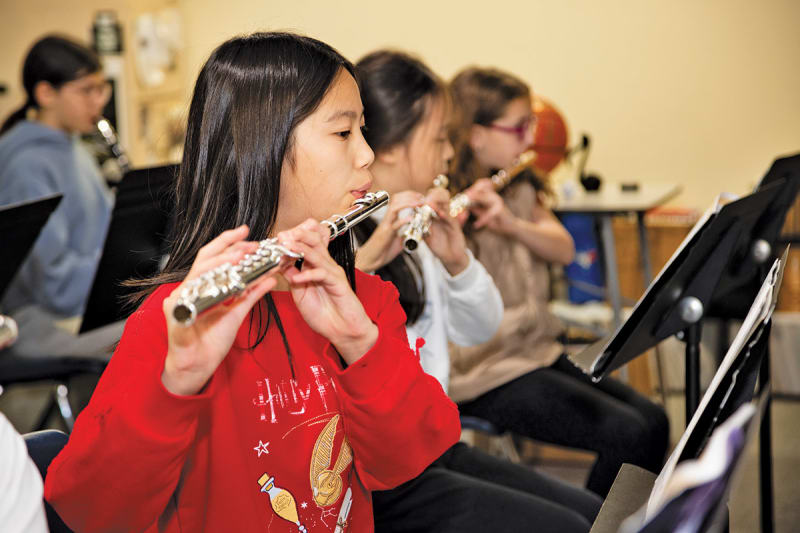
Learning to play musical instruments is one of the wonderful experiences at P.A.C.E. Specialist teachers introduce students to a variety of instruments early on, including woodwind instruments, brass, and percussion. All of the instruments can be rented through the school, or parents are welcome to buy their own. Throughout the year, students learn how to read music, play an instrument, and play as an ensemble. There is also an academic component to music that includes music theory, music analysis, and the comparison of different styles of music, from classical and pop to movie soundtracks.
“Some students who don’t have a music background are a bit nervous at first,” explains the music teacher, “but they quickly understand that there’s no pressure to play at the same level as someone else. Everyone is going to have some strengths and weaknesses, but we’re all learning and performing together,” he says. “I always explain that music takes time.”
While he spends time on the fundamentals for students who don’t have a music background, others have already achieved a certain level of musical accomplishment. “I try to cater to their specific level so they aren’t forced to learn the basics all over again,” he says. “If a student wants to learn how to compose music or pursue different types of musical theory, I help them achieve that.”
There is even more to the music experience than what happens in the music room. For instance, technology is used to help students compose music and understand music theory. Music field trips to the Toronto Symphony Orchestra with the Grade 6-8 music classes teach students etiquette and how professional musicians practice and perform. Toward the end of the year, the entire music program culminates in an annual concert at the Richmond Hill Centre for the Performing Arts. The concert features all students in Grades 1-8. From Grades 1-4, there are different choirs, as well as recorder ensembles for Grade 3s and ukulele ensembles for Grade 4s. In Grade 5 and up, students can play in instrumental band ensembles. After rehearsing, students perform in front of an enthusiastic audience of family and friends.
Students also look forward to a year-end performance at the Festival of Music at Canada’s Wonderland. This is a judged performance, where students have the chance to work with a conductor and receive feedback from experts in the field. “It’s also a chance to showcase their skills and understand how to adjust and adapt,” the music teacher says.
Each year, the music teacher always feels proud of what his students have accomplished. “Music is a great way to be creative, build self-esteem, and overcome their fears of performing for an audience.”
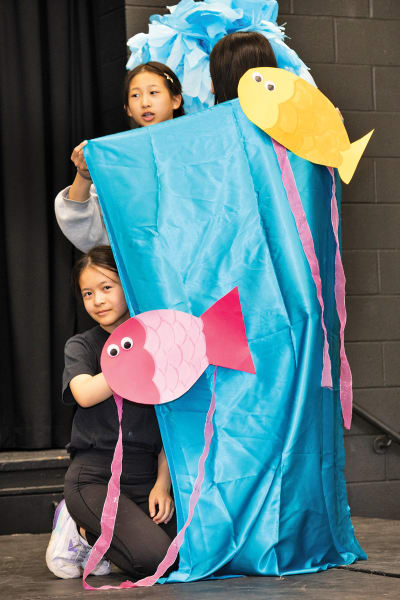
Part of the music program includes vocal music as well as musical theatre. A specialist teacher guides Grades 1-4 students through the vocal music experience and acts as the musical theatre director and choir director for Grades 4-8. “Gifted students experience the world in unique and intense ways,” says the musical theatre director. “Performing arts provide a vital outlet for their sensitivity, and this musical outlet enables them to channel their energy and ideas in a collaborative setting. It’s a magical experience to work with kids so in tune with their emotional side.”
During our visit, the musical theatre teacher was in the gym with the Grade 3 and 4 girls. They were in the middle of practicing a performance for the upcoming end-of-year showcase at the Richmond Hill Centre for the Performing Arts. (The boys were preparing their own performance.) The group sang in unison and moved to the music, while the musical theatre teacher guided the group through a final rehearsal.
The teacher explains that they had put together a piece that combined The Lion King and Barbie. “We’ve been working on their vocal technique, performance, and music theory, and integrating all of it into a big final performance.”
While the end-of-year music performance is exciting for everyone, she also organizes a musical performance before the December break. “It’s a celebration of everyone’s beliefs. There’s always a performance happening at some point! You’d think it would be draining, but the energy of the students and their hunger and curiosity is energizing. It takes lots of extra prep but it’s so worth it at the end when students feel so empowered and confident. It’s exciting to be a part of it.”
One of the students inspired by the musical theatre program is a Grade 2 student named Celine. “I like school,” she smiles. “I like music, drama, and physical education. I also love performing. That’s why I love drama. I also go to ballet at P.A.C.E. after school.”
Many students have had similar experiences. “I always liked singing, but I was shy,” says Ohana Mai, a recent P.A.C.E. graduate. “Then I got involved in school plays and the after-school musical theatre club. I found out I loved performing. I didn’t think I’d like acting on stage, but it was really fun,” she says. Ohana attended the school from Grades 4 through 8. In addition to musical theatre, she says she loved P.A.C.E.’s welcoming community, the challenging curriculum and the support she received from teachers. While science was her favourite subject, she also discovered something else about herself. “I realized you don’t have to be scared to push yourself because there’s always someone there to help you out. You should definitely give it a shot.”
French
In some public schools, students don’t begin learning French until Grade 4. But at P.A.C.E., French begins in Grade 1. As the French teacher explains, “By Grade 4, P.A.C.E. students have acquired a plethora of vocabulary, conjugation, and grammar, and know how to construct a sentence.”
In Grade 5, French becomes even more challenging as students learn to conjugate future, present, and past tenses, concepts that aren’t taught until Grade 7 or 8 in public school. “We are much more advanced. We have a broad curriculum that tackles written and oral expression and communication, reading comprehension, conjugation, grammar, and community service projects,” she explains.
Recently, the Grade 6 students did a project to help raise money for homeless people. “We wrote a letter to our local MP to talk about our concerns about homelessness in the area,” says the French teacher. “It was a great way to teach compassion and help the community. We also did a project on Canadian celebrities and displayed those projects in the hallway. It was all about how those celebrities helped the community, and it was all done in French.”
Students in the upper grades have gone on trips to Ottawa and Quebec City to practice their French in a real-life setting. Some have even participated in speech competitions against other private schools. “We competed at a regional competition at two different levels, and we won first and second place in prepared and unprepared speeches. Our curriculum is amazing.”
She loves teaching gifted children the French language and culture. “I see the results, and I see the passion in their eyes. I see that they are interested. And how they develop their skills in communication, comprehension, writing, and conjugation is wonderful.” As Canadians, our student are fortunate to have the opportunity to be immersed in a program that supports their bilingualism.
Social studies and current issues
Social studies is a broad subject that explores how different societies function. It’s a combination of history, geography, economics, entrepreneurship, and political science. At P.A.C.E., social studies allows students to learn about the world, to ask questions, and have meaningful conversations and experiences. Social studies at P.A.C.E. is delivered through an in-house program called “Theme,” where culminating learning experiences target a variety of learning styles that hone the students’ research and presentation skills.
“We have mind-blowing conversations,” says a Grade 3 Theme teacher. “The students are so curious, thoughtful and interested in what they’re learning. It’s so far beyond what an eight-year-old typically learns. It makes each day interesting and different.”
The day of our visit, for example, the class was talking about how one person’s trash can be another’s treasure. “One student explained that wealthy people would discard their lobster scraps. Poorer people added bread and butter, and it became a lobster roll.” The teacher described the discussion as fascinating and commented on how wonderful it is when students share information and add to it. “Ideas bounce around the whole class, and it creates a nice conversation.”
During another Theme unit on ancient Egypt, the teacher created a market and put together a hands-on learning activity. “At the market, kids had different items they could barter and trade to learn how things were purchased in the past. It was very interactive and a way to immerse them in their learning.”
Rather than sitting in their seats, students moved around, talked to one another, discussed, bartered, and traded. “They came up with a lot of interesting things to barter. I wanted them to learn about it in a way that wasn’t reading what bartering was; I wanted them to experience it using items from their own life,” says the teacher. “Making connections from their own lives to past experiences was a good way to learn about it.”
Another aspect of the curriculum involves discussing current events and analyzing the news of the day. “We had a lot of conversations about the election,” says the current events teacher. “Some kids were really interested in politics and had strong opinions, and others didn’t know how elections worked. There are varying levels of knowledge, so the class is an opportunity to talk about whatever it is that’s on their minds.” She says the class is a great way to broaden their perspective, put the news into context, and ask questions.
“The kids really want to learn,” she says. “They are interested in everything. The discussions they have are great, which is really exciting, especially as a teacher.”
As a parent, Tim is especially “shocked and amazed” by the Theme curriculum. “They talk about government in Grade 4 and explain Liberal, Conservative, left, and right. Teachers give students an opportunity to play a role and see how they will discuss different matters,” he says of his daughter’s year in Grade 4. “It’s important because I see that my daughter is asking questions. I’m glad she’s in an environment that makes her curious to know more because I love to explore these issues with her. I’m glad P.A.C.E. gives me the opportunity to enrich her more. I don’t think public schools do this at all.”
Another parent, Kulbhushan Talwar, agrees. “Personally, I feel that both my children have started to become more developed thinkers and express their thoughts more confidently. For example, my kids have become more effective communicators because they are motivated to share their ideas and present their work to the class, which I feel builds character and transferable skills.” He also believes students benefit from the Theme curriculum. “My kids are excited to tell us about what they learned in school, as the topics are connected to real-world problems. This sparks discussion in our family, and truly brings us together.”
Homework policies
A supervised homework period is scheduled each day from 3-3.45 p.m. It’s a chance for students to review upcoming projects and assignments with teachers, get a head start on their homework, and ask their teachers any questions they may have.
Any homework that is assigned is intended to develop students’ work ethic, time management, and organizational skills. While each student works at a different pace, in general, the school aims for the following nightly time commitment: Grades 1-2: 30 minutes; Grades 3-4: 45 minutes; Grades 5-6: 60 minutes; Grades 7-8: 1.5 hours.
“The school offers a homework period in which students can go to their teachers and ask them about any doubts they have,” says Kulbhushan, whose child, Ivar, is a recent P.A.C.E. graduate. He has another child who is a current student at P.A.C.E. Of all the many reasons for enrolling his children there, he believes the teachers’ commitment to their students is one of the key highlights. “They are passionate about what they teach the kids, and it is easy to get in touch with them, both as a parent and for my children. Since the curriculum is accelerated, the students are pushed to uncover their true potential, and the teachers play a key role in that.”
To further support students, families receive monthly calendars in advance so they can plan for upcoming tests and assignments. Like all students, gifted students also have their individual strengths and weaknesses, so the school supports students who are struggling by providing extra help. Students can also contact teachers by email.
“In my old school, teachers didn’t help each individual student as well. Here, if you need something explained, teachers will help you with that,” says Mia, a Grade 7 student, who began at P.A.C.E. in Grade 4. She also likes the school’s smaller size. “There are fewer people here, which is nice because we connect with each other.”
Franklin, a busy Grade 7 student, believes getting after-school help with homework helps him stay on top of his activities. “I love the education here. My favourite subjects are science, and I like outdoor sports. I’m in the concert band and I play trumpet, too. I like the extended homework period, as well.”
Leadership opportunities
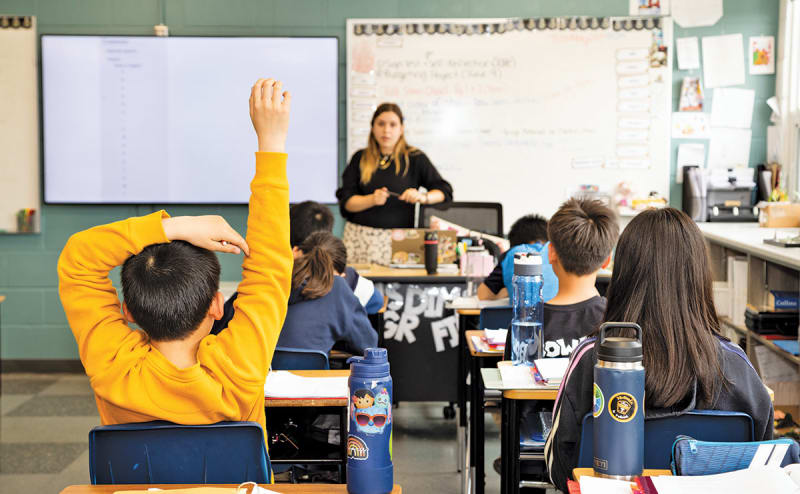
Providing students with leadership opportunities is an important part of the P.A.C.E. experience. It enables students to develop personally and to contribute to their class and society. It’s also a great way to build communication and interpersonal skills, mutual respect, independence, and good citizenship. That is why several leadership opportunities are offered to students in Grades 6-8. For example, students can serve as lunch or homework helpers for the youngest students. They can volunteer as a peer tutor, an extracurricular assistant, an assistant coach, or a weekly food day helper. They can also participate as a Science Odyssey peer mentor, school show stagehand, or choreographer for the school’s large-scale creative arts performances. Many enjoy being on the yearbook committee or serving as a student council member or class representative. Having leadership opportunities at school is also a great way for younger students to develop respect for others and a commitment to citizenship, as one day they will take on leadership roles as well.
Athletics
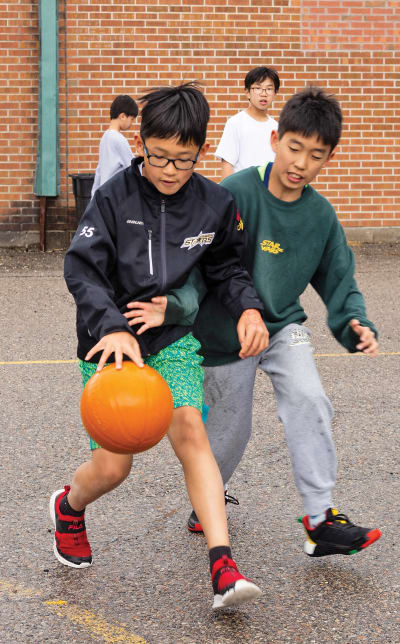
Joanne Abela, Vice Principal and Athletic Director, explains that P.A.C.E. is part of the Small School Athletic Federation, which provides students at 57 private schools across the Greater Toronto Area with a chance to compete in sports. Many athletic events are offered throughout the year, before school, after school, or during the school day. Students can compete in a range of sports, including basketball, volleyball, soccer, cross country, dodgeball, track and field, ultimate frisbee, flag football, and even bowling. There are co-ed teams as well as girls’ and boys’ teams. Most sports have tryouts, but some teams are open to anyone.
“We’ve had some great success,” explains one of the coaches at P.A.C.E. “We’ve won some team sports like volleyball and ultimate frisbee. In individual sports, one of our students won first place and competed in nationals. In track and field, some of our runners and long jumpers have gone far.”
Having sports at P.A.C.E. is an important part of the program. It teaches teamwork, responsibility, social skills, and acceptance. Coaches explain to students that they won’t always win, but it’s important to enjoy the moment when they do. “We’ve had incredible moments of winning and also had disappointments. It’s part of the process and an important part of the learning experience,” says the coach.
Some students at P.A.C.E. are high-performance athletes. Teachers will work with them to make accommodations for any missed school days. This enables gifted athletes to compete at the highest level and also excel in school. Teachers explain that work is provided ahead of time, or students can catch up when they return. “They aren’t penalized for missing class to attend tournaments,” Abela says. “Sometimes the gifts are spread across a number of disciplines. We want families to explore and pursue areas of interest and strengths beyond school. We do whatever we can to support that.”
Extracurricular activities
Curtis began at P.A.C.E. in Grade 1. “At the beginning of the year, I missed my old school. Then all of a sudden I was happy,” says Curtis, who enjoys computers, gym, and recess. He also participates in several extracurricular activities, which make P.A.C.E. even more fun. “I also like Mad Science, soccer, chess, and coding. Engineering Brixology is my favourite. I also play piano and violin.”
Indeed, P.A.C.E.’s well-rounded approach to education caters to the whole child with lunch-time intramural sports, three recesses a day, and an array of extracurricular activities from 3.45-4.25 p.m. following the supervised homework period. “Students can try something new to uncover an unexpected passion or pursue existing interests,” explains Abela, who also coordinates the extracurricular programs at P.A.C.E. Extracurricular activities are a chance for students to intermingle, develop social skills, meet new friends, and interact with like-minded peers. Physical activities include everything from playing on sports teams like soccer, flag football, ultimate frisbee, volleyball, and basketball to competing in track and field. Other extracurricular options include ballet, robotics, magic, engineering, sketching, and robotics, to name a few.
“I’ve been here since Grade 1 and it’s so much fun here,” says Audriana, a Grade 5 student. “We have all these extracurriculars to choose from—they are beyond amazing. There are just so many. No matter who you are, there’s a space for you and a club for your interests,” says the student, who participates in musical theatre, sketching, soccer, and drama.
As a parent, Winnie was thrilled to discover that her daughter loves musical theatre. “My daughter also found dancing,” she says. “We didn’t even know she was interested in it, and now she’s busting a move everywhere we are. It rounds her out.” With two children at P.A.C.E., both of whom play piano at home, she says that being exposed to other things lets them find what they’re passionate about. “My son tried out for everything,” says Winnie. “From that aspect, school isn’t just academic. The opportunity to compete in sports is still there.”
She drives an hour to get her kids to P.A.C.E. each day, but believes it’s worth it. “That fact alone speaks volumes,” she says. “This past year has been amazing for them and for us as parents, knowing how much they are provided for in terms of personal development. This is the school for us.”
With different activities being offered every day, parents sign their children up for classes in advance. While teachers run some, others are run in collaboration with other specialized organizations. In these cases, additional fees may be required and after-care is provided until 5 p.m. at an extra cost as well.
Collaboration, competition and hands-on learning
“We decided to have both our kids at P.A.C.E. because we were very impressed with the strong academics,” says Neha Singla Gupta. She has two children at P.A.C.E.—in Grade 8 and Grade 5. They’ve both been there for several years. The transition wasn’t easy at first, but the collaboration between families and teachers made a huge difference. “We are very thankful to our son’s Grade 2 teacher, who was very patient when he began and kept me involved in how our son was progressing and informed us of his challenges,” says Neha. “She really guided us and held our hands through the journey from public school to P.A.C.E.”
Her son wasn’t used to homework or reviews, but now, “he’s transformed into a child who does all his responsibilities and assignments,” says Neha. “He’s diligent and works hard. He has come a long way from where he was. P.A.C.E., in no small measure, contributed to that.”
Neha says the teachers were so kind and reassuring that her son has gone from a shy child to one who participates regularly in class and even played a part in the school production. “It was amazing for us to see how far he’s come along.”
Not only does P.A.C.E. provide a supportive environment for students and parents, but there are also many opportunities for students to shine. With drama performances, science fairs, spelling bees, essay contests, and math competitions, students are able to extend beyond their comfort zone.
Beginning in Grade 3, students begin participating in math contests. “We compete in national contests,” says one teacher who helps with the competitions. “This year for the Canadian Math League, we came in first in Canada for Grade 6. One student got a perfect score, and five got only one or two questions wrong.”
Teachers practice with the students, and tests take place in the classroom. Everyone participates. “Scores don’t go toward their math mark, so it takes away the pressure while giving them an opportunity to try something different,” says the teacher. “Students often struggle with fear of the unknown, so we give them information ahead of time. It teaches them how to problem solve, be flexible, and work in groups to practice. It becomes fun.”
P.A.C.E. registers with the University of Waterloo, Math League, Canadian Mathematical Society, and Mathematica Centrum for math competitions. P.A.C.E. students have also participated in Odyssey of the Mind and Rube Goldberg competitions, thrilling experiences that allow students to creatively think through real-world problems using effective teamwork. P.A.C.E. has ranked nationally in math, science, and robotics, and in both creative and expository writing competitions.
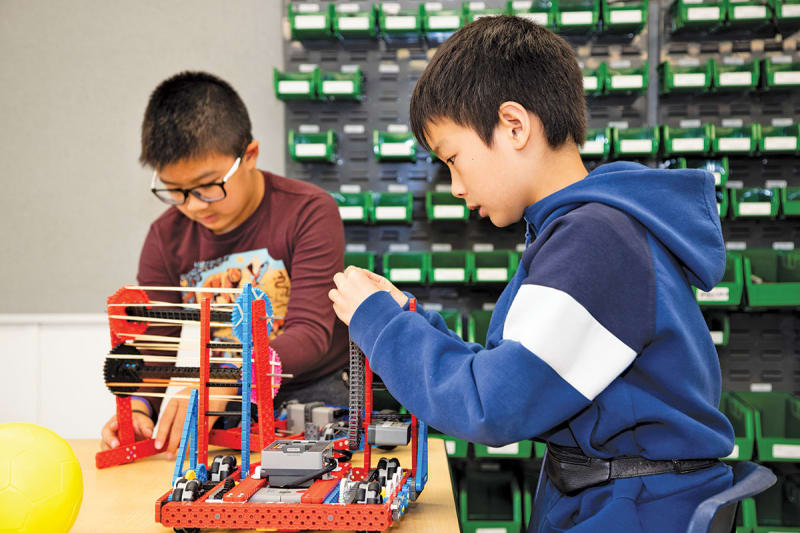
In addition to participating in competitions, P.A.C.E. also creates an inspiring environment where students learn by doing. “Students design and test hypotheses and learn how to become inventors and engineers,” one teacher explains. “Our strong robotics program, for example, allows students to focus on designing, building, and coding. Working through trial and error and embracing the mess, practicing reflection, and coming up with the best possible products is all part of the process.”
Another example is how students practice hands-on learning and entrepreneurial skills by participating in Junior Achievement, a competition in which students create a business and compete against students in other parts of the world. The school’s own Owl’s Hollow competition, a spinoff of Dragon’s Den, is another great in-class opportunity for hands-on learning.
We had the chance to see an Owl’s Hollow pitch during our visit. Laughter filled the Grade 6B class as a group of student-entrepreneurs pitched a product to a panel of teacher-judges. The students had made a prototype and a slideshow that appeared on the Smart TV. The group walked their classmates through their financial plan, marketing ideas, and advertising strategy. The commercial they created made everyone, including the judging panel, giggle.
Audriana also loves the participatory learning experiences that take place off the school campus. “We have really fun field trips,” says the Grade 5 student. “We went to the Japanese Canadian Cultural Centre —it was really fun to learn about Japanese culture. We also went to Medieval Times and learned how they wrote.” She also looked forward to the annual two-night Grade 5 trip to Albion Hills. “We’ll go biking, learn about survival, and explore nature. I heard it’s really fun, so I’m super excited.”

Takeaway
P.A.C.E. is an excellent school for highly intelligent students who want a well-rounded, balanced education. With an emphasis on academics, extracurricular activities, and opportunities for healthy competition, P.A.C.E. also provides a supportive environment where students can develop new skills and hobbies, hone their leadership abilities, and best prepare themselves to be successful in life after P.A.C.E.
For Kulbhushan, P.A.C.E. was the optimal choice for his gifted children. His family hasn’t looked back since enrolling at P.A.C.E. “We wanted to ensure that our children were in an academically challenging environment. P.A.C.E. has truly unleashed their potential.”
For families seeking a school that truly understands giftedness, not only as a marker of academic potential but as a complex and multifaceted way of being and relating to the environment, P.A.C.E. stands out. Its commitment to intellectual challenge, emotional support, and whole-child development creates a rare environment where students prepare for academic success and are empowered to learn from thoughtful, meaningful learning experiences under the watchful eyes and caring support of a staff trained in every facet of gifted education.